Regional Cities Victoria Roads Roundtable

VIEW THE PDF DOCUMENT

COMMUNIQUE

17 April 2026


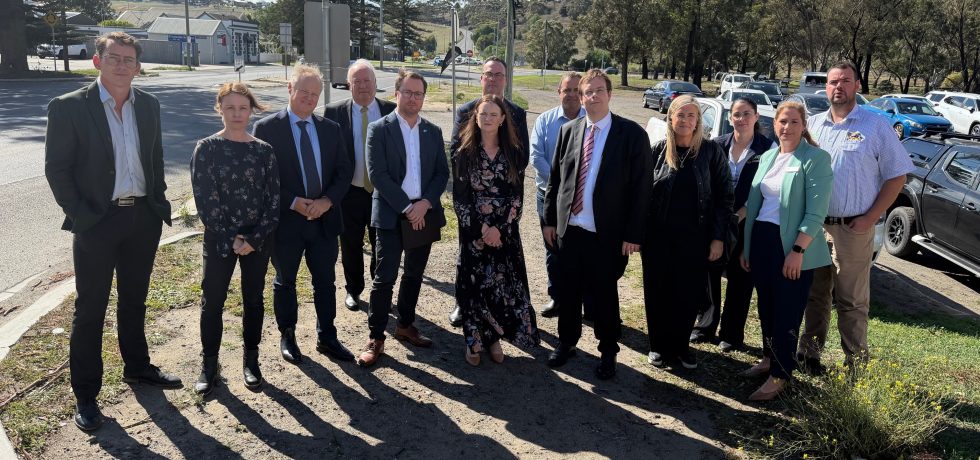
PHOTOGRAPH ATTACHED: L-R

Cr Thomas Prince – Ballarat Mayor, Cr Ali Cupper – Mildura Mayor, Cr Michael Gobel – Wodonga Mayor, Peter Anderson – CEO Victorian Transport Association, Charlie Thomas – CEO Victorian Farmers Federation, Cr Tracey Hargreaves – Ballarat Mayor, Nigel Powers – National Transport Research Organisation, Cr Brian Klowss – Horsham Mayor, Cr Ben Blain – Warrnambool Mayor and Chair of Regional Cities Victoria, Lisa Patroni – CEO Victorian Tourism Industry Council, Alina Hawkins – COO Livestock and Rural Transporters Association of Victoria, Cr Kate Makin – Rural Councils Victoria and Mayor of Corangamite Shire, Joel Haberfield – Livestock and Rural Transporters Association of Victoria Animal Welfare Chair.


Regional Cities Victoria (RCV) convened a regional roads roundtable in Geelong this week bringing together key stakeholders from across Victoria’s transport, tourism, agriculture, freight and local government sectors.

The purpose of the roundtable was to outline RCV’s advocacy for a $2 billion regional roads package ahead of the 2026 Victorian State Election, and to facilitate a shared discussion on the condition, safety and economic importance of the regional road network.

Participants included representatives from the Victorian Tourism Industry Council, Rural Councils Victoria, Livestock and Rural Transporters Association, National Transport Research Organisation, Victorian Transport Association, Victorian Farmers Federation and Mayors and CEOs from Victoria’s 10 largest regional cities.

Thursday’s roundtable provided a forum to share perspectives, evidence and real-world experiences of regional road conditions, and to explore opportunities for coordinated advocacy toward greater investment in the network.

Discussion highlights:

  • Widespread concern about the declining condition of regional roads, with participants citing deteriorating surfaces, potholes and structural failures across key routes.
  • Strong acknowledgement of the safety implications, particularly for heavy vehicle operators, emergency responders and vulnerable road users.
  • Clear evidence that poor road conditions are impacting freight efficiency, agricultural supply chains and tourism access, with flow-on effects for regional economies.
  • Recognition that regional roads are also vital social connectors, enabling people to access family, community networks, education and healthcare, and to participate in activities such as regional sport and recreation.
  • Recognition that current maintenance levels are insufficient to keep pace with network deterioration, leading to a growing backlog of required works.
  • Discussion of the compounding impacts of recent natural disasters and increased freight volumes, accelerating wear and tear on already strained assets.


Points of consensus:

  • Regional roads are critical economic and social infrastructure, supporting both productivity and community connection.
  • There is an urgent need for increased and sustained investment to prevent further deterioration and escalating long-term costs.
  • Safety outcomes on regional roads are unacceptable and require immediate intervention.
  • Investment in regional roads delivers statewide benefits, including improved supply chains, stronger communities and more connected regions.
  • A coordinated, cross-sector advocacy effort is required to ensure regional roads are prioritised in the lead-up to the state election.


Shared commitments:

  • Participants agreed to support a unified advocacy approach calling for increased investment in regional roads.
  • Stakeholders committed to sharing available data, case studies and evidence to strengthen the case for funding.
  • Agreement to continue engagement and collaboration beyond the roundtable to maintain momentum.
  • A shared intent to elevate community awareness of both the safety risks and the social and economic impacts of declining road conditions.


Comments from RCV Chair Cr Ben Blain, Mayor of Warrnambool:

“Regional roads are a safety and productivity issue – potholes and declining asset condition are putting lives at risk and impacting the economic drivers that underpin freight, agriculture and tourism.

This is also about regional people and connection – families, communities and local sport. For many regional Victorians, safe access to everyday life depends entirely on the roads they travel.

Right now, too many regional Victorians can’t rely on the roads they need to get to work, school or sport safely.

We heard loud and clear from industry, and our communities every other day, that the condition of our roads are dangerous and holding regional Victoria back.

A $2 billion regional roads package over four years is an essential down payment on safety and connectivity for economic growth.

This is not just a regional issue – it’s a statewide economic imperative. Investing in regional roads means stronger supply chains, safer commutes and a more productive Victoria.

This roundtable showed there is strong alignment across sectors. We are united in calling for the investment needed to restore confidence in our regional road network.”

 
Media Contact:
Emily Broadbent – 0413 133 627
BACK TO TOP

RCV launches $3bn campaign for regional growth ahead of election

VIEW THE PDF DOCUMENT

MEDIA RELEASE

16 April 2026

Regional Cities Victoria (RCV) will today formally launch its state election advocacy campaign, calling for a $1 billion Regional Fund and a $2 billion Regional Roads Package to secure the future of regional Victoria.

The campaign launch comes as regional leaders, industry stakeholders and media gather in Geelong for a joint event with the Rural Press Club of Victoria.

Chair Cr Ben Blain said RCV’s advocacy was about matching investment to the scale of growth happening across regional Victoria.

“Regional Victoria is doing the heavy lifting when it comes to population growth – but we’re being asked to do it without the investment to match,” Cr Blain said.

“We’ve got the plans, we’ve got the land, and we’ve got the ambition but without infrastructure funding, we’ll struggle to turn strong regional growth into something we can actually sustain.”

RCV’s call for a $1 billion Regional Fund follows the Victorian Government’s decision to discontinue the Regional Jobs and Infrastructure Fund in 2023, leaving a significant gap in regional development funding.

The previous program supported more than 1,000 projects and helped create around 13,000 jobs across regional Victoria.

“When the Regional Jobs and Infrastructure Fund was scrapped, it didn’t just remove funding – it left a gaping hole in economic policy for the regions,” Cr Blain said.

“Right now, there is no dedicated pipeline for the kind of investment that brings jobs, unlocks housing and supports projects of scale for growing communities.”

The proposed Regional Fund would not only support essential infrastructure, housing development and workforce capability – helping cities meet 2051 housing targets – but also co-fund the large transformational projects that regional communities deserve.

Alongside this, RCV is calling for a $2 billion Regional Roads Package over four years to address the deteriorated regional network.

“Regional roads are critical to freight, agriculture, tourism and everyday life, and right now they’re in dangerous disrepair,” Cr Blain said.

“Our roads carry more than vehicles – they carry our economy but most importantly our loved ones.”

The roads package would target both local and state-controlled roads, improving safety, restoring productivity and reducing long-term maintenance costs.

Cr Blain said RCV’s advocacy priorities were essential to making sure regional Victoria can keep up with the pace of its own growth.

“A $1 billion Regional Fund and a $2 billion roads package are not nice-to-haves – they’re the foundation for safe, sustainable growth.”

 
Media Contact:
Emily Broadbent – 0413 133 627
BACK TO TOP

Free public transport highlights deeper transport inequities for regional Victoria

VIEW THE PDF DOCUMENT

MEDIA RELEASE

30 March 2026

Regional Cities Victoria (RCV) Chair Cr Ben Blain, Mayor of Warrnambool, has welcomed efforts to ease pressure on households through free public transport in April, but says the announcement exposes a deeper and long-standing inequity for regional communities.

“We hope this measure helps stabilise fuel supply because for regional communities, businesses and families, reliable access to fuel is not optional, it’s essential,” Cr Blain said.

“But this announcement also highlights a hard truth: regional Victorians are being left behind when it comes to transport investment.”

Cr Blain said that while public transport will be free across the state, many regional communities will see little benefit due to networks that are not fit for purpose.

“Regional Victorians will be effectively subsidising free public transport for Melbourne, while being left with services that are less reliable, less connected and underinvested,” he said.

“For many people in regional areas, public transport simply isn’t a viable option for getting to work, school or daily life.”

Local bus networks in most regional cities have not been reviewed in more than 15 years, exacerbating the lack the coverage, frequency and integration needed to support growing populations and modern commuting patterns.

“Free fares are not the issue, the network is. Without serious investment in regional bus services, people will continue to rely on their cars, regardless of whether public transport is free.”

Cr Blain also noted that regional rail services, with low-cost fares, are frequently operating at capacity.

“Making services free without increasing capacity risks worsening overcrowding rather than improving access,” Cr Blain said.

These public transport challenges reflect a broader pattern of underinvestment across regional infrastructure.

“Just as regional public transport has been left behind, our regional roads have also been allowed to deteriorate after years of neglect,” Cr Blain said.

“This is not just a transport issue, it’s a productivity, cost-of-living and equity issue for regional Victoria.”

Cr Blain said the current situation should act as a catalyst for more meaningful reform.

“We appreciate all short-term efforts to safeguard fuel supplies, but if the Government is serious about supporting regional growth and easing cost-of-living pressures, it must commit to long-term investment in regional transport – both public and roads – that is fit for purpose, reliable and built for the future of our cities.”

 
Media Contact:
Emily Broadbent – 0413 133 627
BACK TO TOP

Regional Cities Victoria to raise fuel security concerns in Canberra 

VIEW THE PDF DOCUMENT

MEDIA RELEASE

17 March 2026

RCV has written to the Federal Energy Minister calling for regional communities to be prioritised in the event of serious supply disruptions. 

“The Commonwealth has powers under Australia’s fuel security legislation to manage supply during emergencies,” RCV Chair Cr Ben Blain said. 

“If supply becomes constrained, regional communities and industries must not be left at the back of the queue.” 

A delegation from RCV will raise growing concerns about fuel prices and supply reliability during meetings in Canberra next week. 

Cr Blain said escalating tensions in the Middle East and the resulting volatility in global fuel markets were already placing pressure on regional households, businesses and industries. 

“When prices rise or supply tightens, regional communities feel it first and hardest,” Cr Blain said. 

“Our regional cities are key freight hubs that connect farms, factories and communities to the rest of the country. Access to fuel cannot be optional – it is essential.” 

RCV is particularly concerned about the impact on smaller rural towns and farming communities – already dealing with drought conditions and bushfire recovery – where fuel underpins almost every aspect of agricultural production and transport. 

“Fuel supply is not just an economic issue in these areas, it’s critical to the survival of local industries and communities,” Cr Blain said. 

“When fuel costs surge, it becomes more expensive to move goods in and out. That puts pressure on local businesses, local jobs and the cost of living not just for the regions but for everyone. 

“That’s why we’ll be taking this issue to Canberra next week and asking the Federal Government to ensure Victoria’s regional communities – and the rural towns they support – are protected if fuel supply pressures escalate.” 

 
Media Contact:
Emily Broadbent – 0413 133 627
BACK TO TOP

RCV welcomes Coalition’s commitment to work with regional councils

VIEW THE PDF DOCUMENT

MEDIA RELEASE

27 February 2026

Regional Cities Victoria (RCV) has welcomed the Victorian Coalition’s first housing policy announcement, particularly its commitment to work directly with councils to build new homes and support sustainable growth across regional Victoria.

RCV Chair Cr Ben Blain, Mayor of Warrnambool, said recognising councils as partners in housing delivery was essential to restoring confidence in home ownership.

“Housing delivery requires genuine partnership with regional councils who understand their communities,” Cr Blain said.

However, Cr Blain warned any housing ambition must be matched with infrastructure investment.

“Regional councils have land ready to unlock for housing development, but without investment in enabling and trunk infrastructure – water, sewerage, power, roads and drainage – homes become less affordable,” Cr Blain said.

“That is why RCV is calling for a dedicated $1 billion Regional Fund to underwrite the infrastructure that gets homes built faster, invests in the liveability regional Victorians deserve, and supports long-term economic growth.”

Cr Blain said a dedicated regional fund would also return investment for community infrastructure such as creative, sporting and transport precincts that underpin liveability, and help fast-track job-creating precincts that have stalled since the Regional Jobs and Infrastructure Fund was scrapped in 2023 by the Victorian Government, leaving a significant gap in regional development policy.

“The discontinuation of the RJIF took a proven economic driver out of local economies,” Cr Blain said.

“RCV is seeking practical, funded commitments that can be implemented quickly and deliver measurable benefits for economic growth that benefits the entire state.”

 
Media Contact:
Emily Broadbent – 0413 133 627
BACK TO TOP

Billions for Crooks, none for the regions

VIEW THE PDF DOCUMENT

February 2026

OPINION

If this were a medieval tale, I suppose I’d be cast as Robin Hood.

Not because I wear green tights or roam Sherwood Forest – but because I’m standing outside the gates of power asking why the treasure collected from the people isn’t finding its way back to them.

According to allegations now emerging, up to $15 billion from Victoria’s metropolitan Big Build may have been funnelled through the CFMEU to bikie-linked interests.

In the old legend, the Sheriff of Nottingham took from the many and protected the powerful.

In modern Victoria, regional communities are wondering whether something similar is happening – whether money raised from taxpayers across this state went into vast metro projects, only to be siphoned away from the public good.

And while this was happening, regional Victoria was being told there wasn’t enough money for our projects.

In 2022, just prior to an election, we were promised the Commonwealth Games, then told they would cost around $7 billion – too much. The Games were dumped and Victorians paid hundreds of millions so others could host them.

In 2023, the Victorian Government scrapped the Regional Jobs and Infrastructure Fund – an investment program that once allowed councils to partner with the Commonwealth and private sector to deliver the infrastructure that underpins homes, jobs and liveable communities.

Now it’s practically government folklore, but for decades it was practical governance.

It helped deliver community hubs, sporting facilities, revitalised town centres and economic precincts. It was how regional Victoria turned opportunity into delivery.

We desperately need it back.

But we aren’t storming the castle for $15 billion, and I won’t be wearing tights.

Instead, we are proposing a transparent plan for $1 billion investment in regional Victoria.

One billion dollars – to restore a Regional Fund that unlocks up to 300,000 homes by funding the pipes, poles, roads and services that make development possible.

One billion dollars – to back investment-ready economic drivers like the inland port in Wodonga, the Circular Economy Precinct in Ballarat, the Clean Energy Centre of Excellence in Warrnambool and the Aerospace Technology Precinct in Latrobe.

One billion dollars – to build the community infrastructure that attracts families and businesses.

Stop taking from regional Victoria and start giving back. It’s not like we’re not already contributing.

We generate more than 25 per cent of Australia’s global food and fibre exports. The Regional Movers Index shows our cities leading population growth as people choose opportunity beyond the capital.

Robin Hood wasn’t about rebellion. He was about correcting imbalance when the system lost its way. In every good legend, the imbalance is corrected.

Regional Victoria is ready to build homes, create jobs and drive growth.

All we are asking is that the wealth collected from Victorians is used for Victorians – openly, responsibly and in places ready to turn it into happily ever after. The End.

Cr Ben Blain is Chair of Regional Cities Victoria and Mayor of Warrnambool


Media Contact:
Emily Broadbent – 0413 133 627
BACK TO TOP

Victorian bushfires: Statement from RCV Chair Ben Blain

VIEW THE PDF DOCUMENT

10 January 2026

MEDIA RELEASE

Regional Cities Victoria (RCV) extends its deepest thanks and unwavering support to the volunteer firefighters of the Country Fire Authority, alongside Victoria Police, Ambulance Victoria, State Emergency Service volunteers and all emergency services responding to the current bushfire emergencies across our state.

These fires are unfolding in fast-moving, unpredictable and dangerous conditions. For many CFA volunteers, this is not only a professional and physical test, but a deeply personal one. Across regional and rural Victoria, volunteers are fighting fires to protect their neighbours and communities, even as their own homes and families remain under threat. Their courage, selflessness and endurance over many days and nights of sustained response represents the very best of Victoria.

We also acknowledge the extraordinary work of local governments across regional Victoria. Councils have activated emergency response plans, established evacuation centres, and are providing safe shelter for residents and their pets, often at very short notice. Local governments are coordinating food relief, welfare support and community services for people who have been displaced or who may have lost their homes, working in conjunction with community organisations and state agencies.

At times like this, the strength of regional Victoria is found in its people – volunteers, frontline workers, councils and communities standing together under immense pressure.

Our thoughts are with everyone affected. RCV stands with our member cities and their communities as this situation continues to evolve.

 
Media Contact:
Emily Broadbent – 0413 133 627
BACK TO TOP

Regional Cities Victoria announces new leadership team for 2026

VIEW THE PDF DOCUMENT

12 December 2025

MEDIA RELEASE

Regional Cities Victoria (RCV) has today elected its new leadership team for 2026, with Warrnambool Mayor Cr Ben Blain appointed Chair, alongside Wodonga Mayor Cr Michael Gobel as Deputy Chair.

RCV is a powerful alliance of Mayors and CEOs from Victoria’s 10 largest regional cities – Ballarat, Bendigo, Geelong, Horsham, Latrobe, Mildura, Shepparton, Wangaratta, Warrnambool and Wodonga – united in their vision for stronger, more sustainable growth across regional Victoria.

“As we head into a state election year, RCV is focused on championing the policy settings that will unlock population growth, strengthen liveability, and expand economic prosperity across regional Victoria,” Cr Blain said.

“Our cities are ready to be part of the solution – supporting housing supply, attracting new industries and creating a thriving future for Victorian families.”

Deputy Chair Michael Gobel, Mayor of Wodonga, said sustained investment in regional cities would be critical to shaping Victoria’s future.

“Our regional cities are central to what makes Victoria so great. As more people choose regional Victoria for its opportunity, lifestyle and affordability, we must match that growth with the jobs, housing and essential community infrastructure needed to support it,” Cr Gobel said.

Following recent mayoral elections, RCV has also welcomed three new mayors to the table: Cr Ali Cupper (Mildura), Cr Thomas Prince (Bendigo), and Cr Brian Klowss (Horsham) and we look forward to their contributions.

2025 RCV Chair and Mayor of Greater Shepparton, Cr Shane Sali, will continue as an active member of the alliance.

“Leading RCV has been an honour. Our shared advocacy has strengthened the voice of regional cities and positioned them as a key part of Victoria’s economic and social future. While I am stepping back from the Chair role, my commitment to this alliance remains strong, and I look forward to supporting the next phase of RCV’s leadership,” Cr Sali said.


New RCV leadership for 2026: (L-R) Deputy Chair Cr Michael Gobel, Mayor of Wodonga and Chair Cr Ben Blain, Mayor of Warrnambool.
 
Media Contact: Emily Broadbent – 0413 133 627
BACK TO TOP